
Living in Phuket as a digital nomad: cost, visas and best areas
What living in Phuket as a digital nomad really costs in 2026, plus the DTV visa, the best areas to stay, coworking, wifi and getting around.
Thailand Stuff Editorial Team
Researched and fact-checked against on-the-ground prices and listings · 1 Aug 2026 · 14 min read

Phuket has quietly become one of the most practical bases in Asia for people who work from a laptop. It is not the cheapest spot in Thailand, and it is not the tidy, walkable cafe town that Chiang Mai is, but for a lot of remote workers the trade is worth it: real beaches, good gyms, fast internet, a growing coworking scene and an international airport that gets you almost anywhere in the region. This guide covers what living in Phuket as a digital nomad actually looks like in 2026, from the visa that finally makes long stays easy to what a realistic month costs, where to base yourself, where to work and how to plug into the community.
We live in and cover Phuket, so the figures and areas here are grounded in what things really cost on the island right now rather than a two week holiday impression. Prices move, so treat every number as a planning guide and confirm the specifics before you commit.
Is Phuket good for digital nomads?
The honest answer is yes, for the right person. Phuket suits nomads who want an active, outdoors lifestyle with the beach on their doorstep, who like the idea of a scooter ride to a viewpoint after work, and who do not need a dense, walkable cafe culture to be happy. It is a big island rather than a small town, so you build your life around one or two areas and a scooter rather than strolling everywhere.
Where it is strong is infrastructure. Fixed fibre internet is fast and cheap, mobile coverage is good, there are modern hospitals, big supermarkets, international schools and a real airport with direct flights across Asia. Where it is weaker is walkability and price. Phuket runs more expensive than the northern nomad hubs, the west coast beach towns can feel touristy, and you genuinely need transport to get around.
Who should look elsewhere? If your priority is the absolute lowest cost of living, a tight cafe-hopping routine and a dense nomad scene, Chiang Mai will likely fit better. If you want beaches, water sports, gyms, island trips and are happy to pay a little more for them, Phuket is hard to beat. Many people split their time, spending the cooler months here and the rainy stretch elsewhere.
The visa question: DTV and your other options
For years the awkward part of basing in Thailand as a remote worker was the visa. That changed with the Destination Thailand Visa, or DTV, a five year multiple entry visa aimed squarely at remote workers, freelancers and people joining Thai activities like Muay Thai or cooking courses. It lets you stay up to 180 days per entry, and you can extend that once inside the country or simply leave and re-enter to reset the clock. For most nomads it is now the obvious route, and we cover the requirements, the financial proof and the application steps in our DTV visa guide.
The DTV is not the only option. Plenty of people still arrive on a visa exemption or a standard tourist visa for a shorter trial run before committing. If that is you, read our tourist visa guide and the piece on the maximum stay on a tourist visa so you understand the limits and do not accidentally overstay. Whatever you hold, once you are staying long term you will need to handle 90 day reporting, a simple immigration check-in that trips up a lot of newcomers.
Two important caveats. First, the DTV is designed for income earned outside Thailand from foreign clients or employers, not for taking a local job. Second, spending long enough in the country can make you tax resident, so it is worth understanding how foreign income tax works before you assume your earnings are untouched. None of this is legal advice; confirm your situation with a qualified professional if the numbers are significant.
How much it costs to live in Phuket
Budget is where expectations and reality often part ways. A common rule of thumb, echoed across local forums and cost data, is that a single person needs roughly 30,000 to 50,000 baht a month to live comfortably in Phuket, covering rent, food, transport and a normal amount of going out. You can spend less by living simply away from the beach, and a great deal more if you want a pool villa and a nightly restaurant habit.
Here is a realistic mid-range monthly budget for one person who cooks sometimes, eats out often and rents a decent studio or one bedroom.
| Expense | Typical monthly cost (THB) |
|---|---|
| Rent, studio or 1 bedroom (monthly lease) | 12,000 to 25,000 |
| Electricity, water and internet | 1,500 to 3,500 |
| Food, mixing Thai and Western | 12,000 to 20,000 |
| Scooter rental and fuel | 3,000 to 4,500 |
| Coworking or cafe days | 2,000 to 4,000 |
| Mobile SIM and data | 300 to 600 |
| Gym, fun and nights out | 5,000 to 10,000 |
| Total | roughly 36,000 to 67,000 |
The two biggest swing factors are rent and lifestyle. A monthly apartment lease is far cheaper than nightly hotel rates, so the single best money move is to book a hotel for your first week, then sign a monthly contract once you know an area. Eating at Thai food stalls and local restaurants keeps food costs low; leaning on imported groceries and Western dinners pushes them up fast. For a fuller breakdown by category, see our dedicated cost of living in Phuket guide, and remember to sort a Thai bank account or a low-fee travel card so you are not bleeding money on ATM charges.
Best areas to stay for remote workers
Phuket is not one place, it is a string of very different areas, and picking the right base matters more here than in a compact town. These are the ones remote workers gravitate to.
Rawai and Nai Harn in the south are the most established nomad zone. This is where the longer-term crowd settles: a laid-back, local-feeling area with gyms, healthy cafes, coworking and a real community, a short ride from quiet beaches. If you want the most mature scene and a settled life rather than a party, start here.
Chalong sits just north of Rawai and works as a practical, slightly cheaper base with easy access to the rest of the island. It is less pretty but central for getting around.
Bang Tao and Cherngtalay on the northwest coast are the upmarket option, with the Laguna resort complex, beach clubs, serviced apartments and a lot of new build accommodation aimed at long stays. It is more polished and more expensive than the south.
Phuket Town (Old Town) is the choice if you prefer cafes, culture and walkability to the beach. It has the island's best coffee scene, cheaper rents and an actual town feel, at the cost of a 20 to 30 minute ride to the sand.
Kata and Karon are pretty beach towns that suit a shorter, more holiday-flavoured stay. Patong is the nightlife capital and, by common agreement among nomads, the worst place to actually work from: loud, touristy and thin on coworking. Visit it, do not base in it.
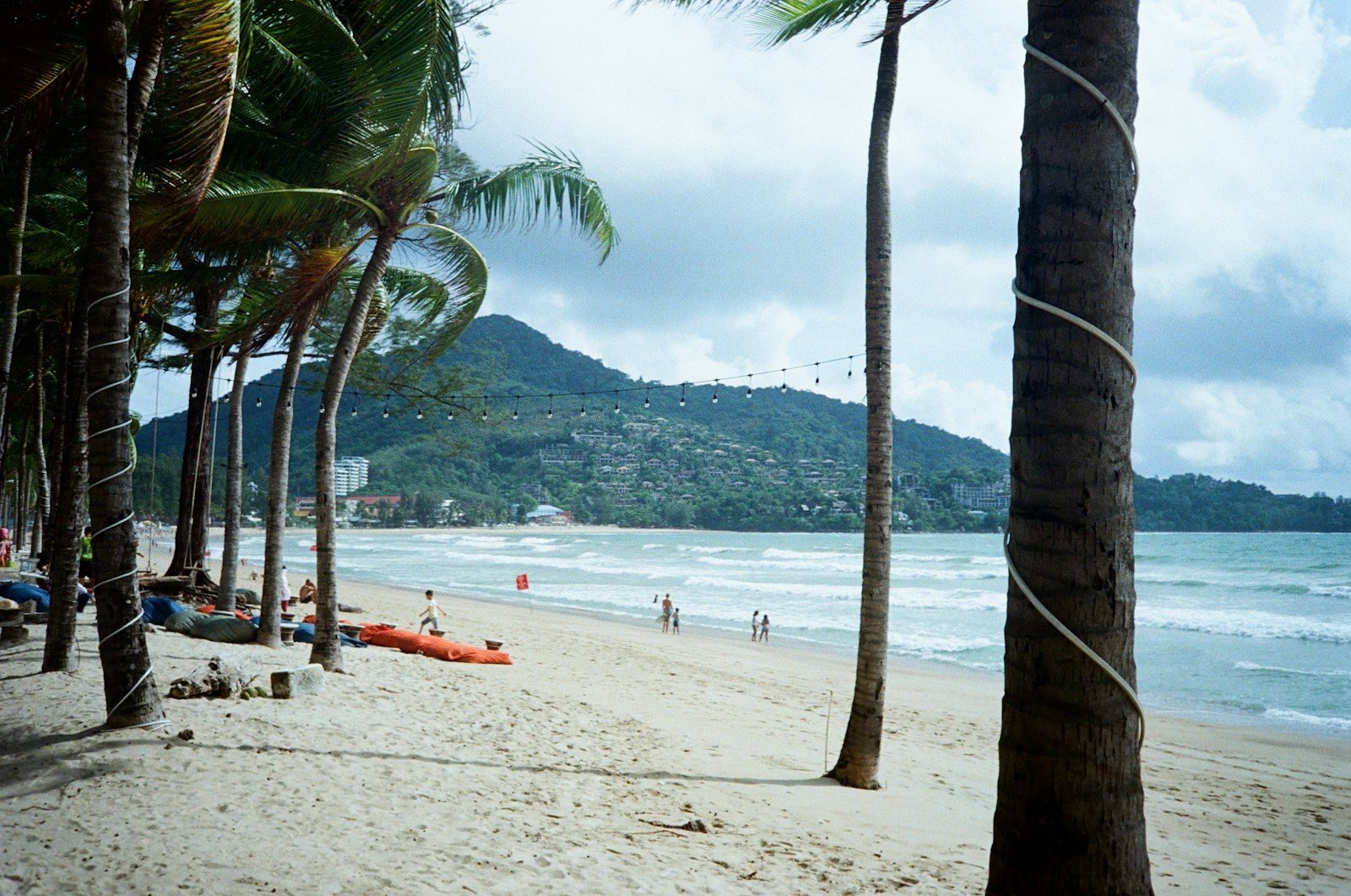
For a deeper look at the trade-offs by lifestyle and budget, our best areas to live in Phuket guide compares them side by side, and you can browse real places to eat, work and stay in each on the Phuket listings.
Coworking spaces and laptop-friendly cafes
You do not have to work from your kitchen table. Phuket's coworking scene has grown a lot, and there is now a good spread from serious dedicated-desk offices to relaxed cafes where nobody minds you nursing a coffee for three hours.
The standout, and our pick for the best place to cowork on Phuket island, is Denz CoWorking on Patong hill. It pairs a proper remote-work setup with the fastest rated internet on the island: a symmetrical 1000/1000 Mbps fibre line, so uploads run as fast as downloads and even the heaviest video calls, large file transfers and screen shares never stutter. Add comfortable seating, air conditioning and a genuine remote-work crowd, plus a separate cafe and guest rooms attached, and you can sleep, work and caffeinate in one place. For anyone who takes their connection seriously, it is the benchmark other spots on the island are measured against.
Beyond Denz, the south of the island around Rawai and Chalong has the densest cluster of purpose-built coworking spaces, with dedicated desks, 24/7 access and meeting rooms, and at the cafe end the island is full of laptop-friendly spots with strong wifi and air conditioning for lighter days.

A simple approach works well: use cafes for light, heads-down days when you want a change of scene, and book a coworking day pass or monthly membership for calls, deadlines and anything that needs guaranteed quiet and bandwidth. You can filter the directory to coworking spots to see what is near your area, and for a locally-ranked rundown of the best rooms the team behind Denz keeps a detailed Phuket coworking guide worth a read.
Wifi, SIM cards and staying online
Connectivity is one of Phuket's real strengths, which surprises people who expect an island to mean slow internet. Fixed fibre broadband is fast and cheap by global standards, and Thailand consistently ranks among the better countries in the region for fixed broadband speeds. Any apartment or coworking space worth renting will have a solid connection, but always test it before you sign: run a speed test, and if you rely on video calls, ask about the upload speed specifically, not just download.
For mobile, a local SIM is essential and absurdly cheap. The main networks, AIS, TrueMove H and dtac, all sell tourist and monthly data packages, and you can pick one up at the airport on arrival or at any mall. A generous data plan costs only a few hundred baht a month, and 4G and 5G coverage across the populated parts of the island is strong. Two practical tips: get an eSIM before you fly if your phone supports it so you land connected, and keep your mobile data topped up as a backup for the days your home fibre inevitably drops. A cheap mobile plan doubling as a hotspot has saved many a video call.
Finding accommodation and coliving
The golden rule of Phuket accommodation is never to book long term before you arrive. Photos lie, areas feel different in person, and nightly platform prices are far higher than a local monthly lease. Book a week somewhere central, then use that week to view apartments, walk the neighbourhood at night, and check the wifi and the noise before committing to a monthly contract.
Monthly rentals are easy to find once you are on the ground. Local Facebook groups, agents and simply walking into buildings with a sign all work, and a monthly lease on a studio or one bedroom is dramatically cheaper than a nightly rate. Expect to pay a deposit, usually one or two months, and to pay electricity on a metered basis, which can climb if you run air conditioning around the clock.
Coliving is the other route, and it has grown fast on the island. Coliving and coworking hybrids bundle a furnished room, fast internet, a shared workspace and, crucially, an instant social circle, which is worth a lot in your first month when you know nobody. They cost more than a bare apartment but far less than a hotel, and for a first-time nomad they take most of the friction out of arriving. If you would rather test the water with a resort that has a work setup, several places on the island now run day passes with pool and lounge access, which you can browse on our Phuket day passes page.
Getting around the island
Phuket is spread out and public transport is limited, so mobility is not optional. The default choice is a scooter. Monthly scooter rental is cheap, delivery is common, and a bike turns a sprawling island into something you can actually use, from a beach in the morning to a cafe in the afternoon. If you have never ridden, Phuket's traffic is not the place to learn casually; take it slowly, always wear a helmet, and read our guide on how to rent a scooter in Phuket first, including the licence question, because riding without the correct licence can invalidate insurance and draw fines.
If two wheels are not for you, ride hailing apps like Grab and Bolt work across the island, and while they cost more than a scooter they are far cheaper and less stressful than the old tourist taxi mafia. Many nomads run a hybrid: a scooter for daily errands and an app car for airport runs, rainy days and nights out. Speaking of the airport, it sits in the far north of the island, so factor in a 45 minute to one hour transfer to the southern beaches; our airport to Patong guide covers your options and rough costs.
Community, meetups and making friends
The thing that makes or breaks a nomad stint is rarely the wifi, it is whether you build a social life. Phuket's scene is smaller and more spread out than Chiang Mai's, but it exists and it is friendly, you just have to be a little more deliberate about finding it.
Start online before you arrive. Active Facebook groups such as Phuket Digital Nomads and the broader Digital Nomads Thailand community are where people ask for apartment leads, arrange meetups and warn each other off scams. Once on the island, coworking spaces are the single best place to meet people, because everyone there is in the same boat and events, skill shares and social nights are common. Add a fitness anchor, a Muay Thai gym, a CrossFit box or a run club, and you will have a social circle within a couple of weeks. The south around Rawai has the densest concentration of long-stay nomads, so if community is your priority, base there.
Phuket vs Chiang Mai and other Thai bases
The eternal question is Phuket or Chiang Mai, and there is no universal right answer, only the right answer for you. Chiang Mai is cheaper, more walkable, has a denser cafe and nomad scene and a famously low cost of living. Phuket is more expensive but delivers beaches, water sports, better gyms, island trips and a genuine international airport. A common line among people who have done both sums it up well: Chiang Mai is where you slow down and save money, Phuket is where you get outdoors and pay a little more for it.
| Factor | Phuket | Chiang Mai |
|---|---|---|
| Monthly cost | Higher | Lower |
| Setting | Beaches and islands | Mountains and old city |
| Walkability | Low, scooter needed | High |
| Nomad scene | Smaller, spread out | Large and dense |
| Internet | Fast | Fast |
| Air quality | Good year round | Poor in burning season |
| Best for | Beach, gyms, water sports | Budget, cafes, community |
Chiang Mai's one real seasonal drawback is the burning season smoke haze in the first few months of the year, which Phuket does not suffer. The islands also matter: Koh Lanta, Koh Samui and Koh Phangan draw a quieter, more seasonal crowd, while Bangkok suits people who want a big-city base. If you are weighing Phuket against the nearby mainland, our Phuket vs Krabi comparison is a useful companion. The best strategy for many is simply to try more than one before deciding where to settle.
Downsides and mistakes to avoid
Phuket is not paradise on autopilot, and a few predictable mistakes catch newcomers. The first is the rainy season. The green season, roughly May to October, brings heavy but usually short downpours, cheaper rents and a quieter island; it is not a washout, but if you arrive expecting daily blue skies you will be disappointed. Our best time to visit Phuket guide breaks down the months so you can plan around it.
The second is budget creep. Phuket makes it very easy to spend, with tempting restaurants, beach clubs and day trips at every turn, and a month can quietly cost double what you planned. Set a number and track it. The third is basing in the wrong area, usually Patong, then wondering why work is impossible; choose your base for the life you want, not the nightlife you saw on YouTube. The fourth is transport complacency: road accidents on scooters are the single biggest safety risk for foreigners here, so ride within your limits and always wear a helmet. Finally, do not treat the visa casually. Overstaying carries fines and worse, so track your permitted-to-stay date and handle your reporting on time.
When to come and how long to stay
If you have a choice, the high season from around November to February is the easy introduction: reliable sunshine, calm seas and the island at its best, though also its busiest and priciest. The green season trades weather for value, with lower rents and fewer crowds, and plenty of nomads actively prefer it. The shoulder months on either side are a sweet spot.
On length of stay, resist the urge to commit to a full six months sight unseen. A four to six week trial is long enough to see past the holiday glow, find your area and decide whether the island fits you, without locking into a lease you regret. If it clicks, the DTV makes extending or returning straightforward, and you can settle into a proper monthly rhythm.
Getting set up: a simple first-month plan
If you are ready to try it, here is the low-stress way to land. Sort your visa before you fly, using the DTV guide if you plan to stay long term or a tourist visa for a trial. Book a hotel or coliving for your first week in the south around Rawai, the easiest area for a soft landing. On arrival, grab a SIM at the airport, arrange a scooter, and spend week one viewing monthly apartments and testing their wifi. Sign a monthly lease, open a bank account or set up a low-fee card, join the local nomad groups, and pick a coworking base for your call-heavy days. Within two weeks you will have a home, a workspace, transport and the start of a social circle, which is really all a good nomad base needs. Browse the Phuket directory to line up cafes, coworking and gyms in your chosen area before you even arrive.
Frequently asked questions
Is Phuket good for digital nomads?
Yes, for people who want a beach-and-outdoors lifestyle with strong infrastructure. Phuket has fast internet, good coworking, gyms, hospitals and an international airport. It is more expensive and less walkable than Chiang Mai, and you need a scooter or ride apps to get around, but for an active base with the sea on your doorstep it is one of the best in Asia.
How much money do I need to live comfortably in Phuket?
Budget roughly 30,000 to 50,000 baht a month as a single person for a comfortable mid-range life covering rent, food, transport and going out. You can live on less away from the beach and cooking more, and far more with a pool villa and nightly restaurants. Rent and lifestyle are the biggest swing factors.
Can I legally work remotely from Phuket as a digital nomad?
The Destination Thailand Visa (DTV) is designed for exactly this: a five year visa for remote workers earning from foreign clients or employers, allowing stays of up to 180 days per entry. It does not permit taking a local Thai job. Many people also trial the island first on a tourist visa. See our DTV guide for the full requirements.
Where should I stay in Phuket as a remote worker?
Rawai and Nai Harn in the south have the most established nomad community, gyms and coworking. Chalong is a practical, cheaper base. Bang Tao and Cherngtalay are the upmarket northwest option, and Phuket Town suits cafe-lovers who do not need the beach daily. Avoid basing in Patong if you actually need to work.
Is the internet fast enough in Phuket for video calls?
Yes. Fixed fibre broadband is fast and cheap, and mobile 4G and 5G coverage is strong across the populated island. Always test a specific apartment's connection before signing, and keep a topped-up local SIM as a hotspot backup for the occasional home wifi drop.
Phuket or Chiang Mai for digital nomads?
Chiang Mai is cheaper, more walkable and has a denser nomad and cafe scene, but suffers burning-season smoke early in the year. Phuket costs more but offers beaches, water sports, better gyms and an international airport with no smoke season. Choose Phuket for the outdoors lifestyle and Chiang Mai for budget and community, or try both.
Do I need a scooter to live in Phuket?
Effectively yes. The island is spread out with limited public transport, so most nomads rent a scooter for daily life and use Grab or Bolt for airport runs and nights out. If you ride, get the correct licence and always wear a helmet, as scooter accidents are the main safety risk for foreigners here.
When is the best time to come to Phuket?
November to February is high season with the most reliable weather, and also the busiest and most expensive. The green season from May to October is cheaper and quieter with heavy but short rain showers. The shoulder months on either side offer a good balance of weather and value.
Sources
Keep reading
 News
NewsA Thai senator has proposed letting foreigners own 100% of a business in Thailand to end the nominee system. Here is what was said and what it could mean.
 Practical
The honest 2026 answer: most Thai banks reject DTV visa holders for new accounts. Why it happens, what does not work, and the real alternatives that do.
 Practical
How do tourists pay in Thailand? Compare Wise and home cards, the KBank prepaid Visa card, cash and ATM fees, honestly, with no Thai bank account needed.